Extensibility of SAP S/4HANA Cloud
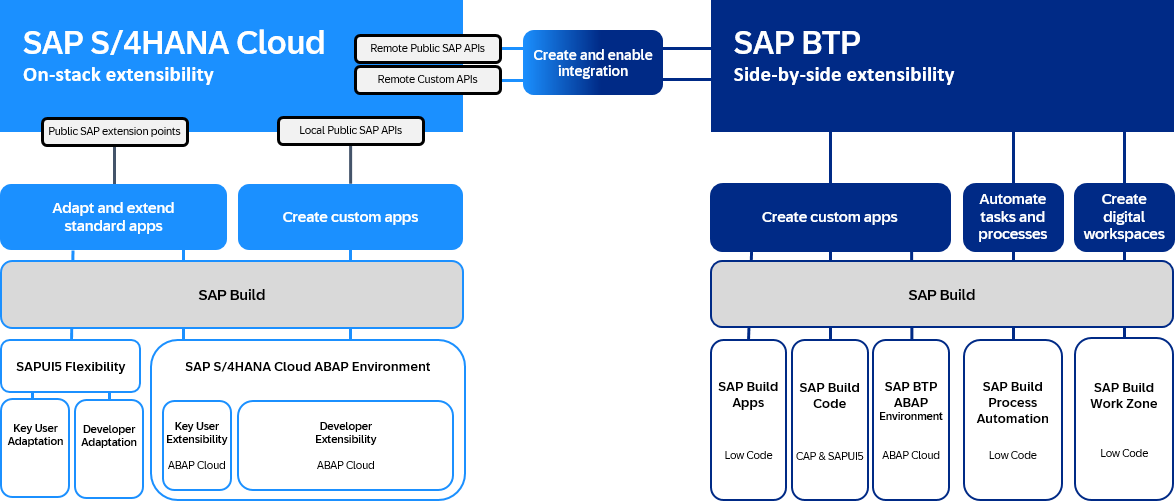
Overview
Every business is unique — and no standard ERP system can address every process out of the box. Extensibility is the capability to adapt, enhance, and expand SAP S/4HANA Cloud beyond its standard configuration without compromising system stability or upgrade safety.
SAP S/4HANA Cloud provides a structured, lifecycle-stable extensibility model that allows customers and partners to:
- Tailor standard processes to unique business requirements
- Build new applications that integrate with the SAP core
- Automate business workflows using low-code and pro-code tools
- Stay upgrade-safe, ensuring extensions survive SAP innovation cycles
The Clean Core Principle
At the heart of SAP S/4HANA Cloud extensibility is the Clean Core strategy. Rather than modifying SAP’s standard code base, organizations build extensions using only:
- Publicly released and stable SAP APIs
- Defined SAP extension points
- Released ABAP objects (when developing on-stack)
This approach minimizes upgrade risks, lowers total cost of ownership, and ensures that SAP innovations can be adopted without rework. Over time, custom code accumulation, undocumented changes, and fragile integrations can weigh down an ERP landscape. Clean Core directly addresses this by promoting upgrade-stable architectures.
Clean Core Extensibility Levels
SAP has evolved from an original three-tier model to a Clean Core Level Concept — a maturity model that classifies extensions into four levels:
| Level | Classification | Description |
|---|---|---|
| A | Fully compliant | Extensions using only publicly released, stable SAP interfaces backed by formal stability contracts. Includes on-stack ABAP Cloud and side-by-side SAP Build/BTP extensions. |
| B | Compliant (classic APIs) | In addition to Level A criteria, uses SAP’s classic APIs — well-defined, documented, and generally upgrade-stable interfaces. |
| C | Partially compliant | Access to SAP internal objects allowed for legacy scenarios. Requires a changelog-based assessment before upgrades. |
| D | Not clean core | Extensions with severe violations: modifications, unapproved SAP objects, or unsupported extension technologies. |
Extensibility Models
SAP S/4HANA Cloud offers two primary extensibility paradigms:
- On-Stack Extensibility — extensions built within the SAP S/4HANA Cloud ABAP environment
- Side-by-Side Extensibility — extensions built externally on SAP Business Technology Platform (BTP)
Both models are designed to deliver flexibility while preserving the integrity of the SAP core.
On-Stack Extensibility
On-stack extensibility refers to extensions developed directly on the SAP S/4HANA Cloud technology stack, using the ABAP Cloud development model within the SAP S/4HANA Cloud ABAP Environment. This approach is available in two forms:
Key User Extensibility (No-Code / Low-Code)
Designed for business users and functional consultants — no programming knowledge required. Using built-in SAP Fiori tools directly in the application, key users can:
- Add custom fields to standard SAP objects and screens
- Create custom business objects with their own data models and UIs
- Define custom logic via business rules and validation
- Adapt SAP Fiori UIs (page layouts, field labels, visibility rules)
- Build simple analytical reports and KPI tiles
This option is tightly integrated with the SAP S/4HANA lifecycle, meaning extensions are automatically included in transport management and upgrade procedures.
Developer Extensibility (Pro-Code / ABAP Cloud)
Designed for professional ABAP developers who need deeper, more complex extensions. Using the SAP S/4HANA Cloud ABAP Environment and standard ABAP Development Tools (ADT) in Eclipse, developers can:
- Write custom ABAP code using the ABAP Cloud development model
- Implement Business Add-Ins (BAdIs) to hook into SAP standard logic
- Create custom CDS (Core Data Services) views for data modeling
- Build SAP Fiori Elements applications using the RAP (RESTful Application Programming) model
- Develop OData services exposed to frontend or external consumers
- Extend SAP standard applications at defined extension points
Governing Principles for On-Stack Development
On-stack developer extensions must comply with the following rules:
- No modification of SAP standard objects is permitted
- Only stable and publicly released SAP APIs, extension points, and ABAP objects may be used
- Extensions must pass ABAP Test Cockpit (ATC) checks to verify Cloud readiness
- All developments follow the SAP RAP programming model for building Fiori apps
Tools & Environment
| Tool | Purpose |
|---|---|
| Eclipse ADT (ABAP Development Tools) | Primary IDE for ABAP Cloud development |
| ABAP Test Cockpit (ATC) | Governance and clean core compliance checks |
| SAP Fiori Elements | Framework for building UI5 apps from CDS annotations |
| RAP (RESTful ABAP Programming Model) | End-to-end model for OData-based Fiori apps |
| Release Object Tree (ADT) | Discover publicly released APIs and extension points |
Side-by-Side Extensibility
Side-by-side extensibility refers to extensions built externally to the SAP S/4HANA system, running on SAP Business Technology Platform (BTP). These extensions connect to the SAP core through remote APIs and events, keeping a clear architectural separation between custom code and SAP standard software.
This approach is particularly suitable when:
- The extension serves users outside the SAP system (e.g., external customers, partners, new departments)
- There is no need for tight transactional coupling with the SAP core
- The team prefers non-ABAP languages (Java, Node.js, Python, etc.)
- The use case demands freestyle UI development (native mobile apps, custom web portals)
- The extension acts as an integration hub connecting multiple systems
Integration with SAP S/4HANA Cloud
Side-by-side extensions connect to SAP S/4HANA Cloud data and processes through:
- Remote OData and REST APIs published on the SAP Business Accelerator Hub (formerly API Business Hub)
- Business Events — SAP S/4HANA can publish events (e.g., sales order created) that BTP extensions subscribe to
- SAP Event Mesh for asynchronous, event-driven integration patterns
- SAP Integration Suite for orchestrating complex cross-system flows
Development Options on SAP BTP
SAP BTP supports multiple runtimes and frameworks for side-by-side extensions:
SAP Build (Low-Code / No-Code)
- SAP Build Apps — drag-and-drop application builder for web and mobile
- SAP Build Process Automation — workflow and RPA automation without coding
- SAP Build Work Zone — unified digital workplace and portal experiences
CAP – Cloud Application Programming Model (Pro-Code)
The SAP Cloud Application Programming Model (CAP) is a comprehensive framework for building cloud-native applications on BTP. CAP simplifies the development of robust, scalable, and secure solutions by providing:
- A declarative data modeling language (CDS)
- Built-in OData service exposure
- Out-of-the-box authentication and authorization
- Seamless SAP S/4HANA integration via remote services
ABAP Cloud on BTP (ABAP Environment)
Developers who prefer ABAP can use the ABAP Environment on SAP BTP to build side-by-side extensions using the ABAP Cloud programming model — combining ABAP expertise with the freedom and scalability of BTP.
Custom Runtimes
BTP’s Cloud Foundry and Kyma (Kubernetes-based) environments allow development in any language or framework, including Java, Node.js, Python, and Go.
Tools & Environment
| Tool | Purpose |
|---|---|
| SAP Business Application Studio | Cloud IDE for developing extensions on BTP |
| SAP CAP (Cloud Application Programming Model) | Framework for scalable cloud-native apps |
| SAP Build Apps | Low-code/no-code app builder |
| SAP Business Accelerator Hub | API catalog and event catalog for S/4HANA integration |
| SAP Event Mesh | Event-driven integration between systems |
| SAP Integration Suite | Enterprise integration and API management |
| Joule (AI Copilot) | AI-assisted code generation across ABAP, Java, JavaScript, and low-code tools |
Choosing the Right Extensibility Approach
Selecting the right model depends on three key factors:
1. Target User Group
| Scenario | Recommended Approach |
|---|---|
| Users already within the SAP S/4HANA system | On-Stack (Key User or Developer) |
| External users: customers, partners, new departments | Side-by-Side (BTP) |
| Mixed audiences | Both, with appropriate integration |
2. Integration Requirements
| Scenario | Recommended Approach |
|---|---|
| Frequent, transactional data exchange with SAP core | On-Stack |
| Occasional or read-only access to SAP data | Side-by-Side |
| Building an integration hub across multiple systems | Side-by-Side |
| Analytical data hub or reporting application | Side-by-Side |
3. Lifecycle Stability
| Approach | Lifecycle Behavior |
|---|---|
| On-Stack (Key User) | Integrated lifecycle — extensions move with the core through upgrades |
| On-Stack (Developer) | Upgrade-safe when ABAP Cloud model and released APIs are used |
| Side-by-Side (BTP) | Fully lifecycle-stable — extensions are decoupled from S/4HANA upgrade cycles |
Extensibility Wizard
The Extensibility Wizard in SAP S/4HANA Cloud Public Edition provides direct, guided access to both on-stack and side-by-side extensibility options from within the SAP system. It helps business users and developers identify the right tool for their extension scenario without needing to navigate complex technical documentation.
Virtual Data Model (VDM)
All extensibility options rely on the Virtual Data Model (VDM) — SAP’s structured, business-friendly data access layer built on CDS (Core Data Services) views. The VDM:
- Exposes enterprise data in a consistent, semantically rich format
- Abstracts complex underlying database tables behind stable, business-meaningful views
- Enables real-time data access while maintaining clean separation from physical data structures
- Is the foundation for both OData APIs consumed by side-by-side extensions and CDS-based on-stack developments
Summary Comparison
| Dimension | On-Stack (Key User) | On-Stack (Developer) | Side-by-Side (BTP) |
|---|---|---|---|
| Target User | Business users, consultants | ABAP developers | Any developer (ABAP, Java, JS, etc.) |
| Tools | SAP Fiori in-app tools | Eclipse ADT, RAP, CDS | SAP BAS, CAP, SAP Build |
| Coding Required | No | Yes (ABAP Cloud) | Yes (various languages) or No (SAP Build) |
| Integration Depth | Tight (in-app) | Tight (in-stack) | Loosely coupled (remote API/events) |
| Upgrade Safety | Fully managed | Safe (with ABAP Cloud) | Fully lifecycle-stable |
| Clean Core Compliance | Level A | Level A (with released APIs) | Level A |
| Deployment | S/4HANA Cloud stack | S/4HANA Cloud ABAP Env. | SAP BTP (CF, Kyma, ABAP) |
| Best For | Field/UI/logic adaptations | Deep ABAP custom logic | New apps, portals, integrations |
References
- SAP S/4HANA Cloud Extensibility — Official Documentation
- ABAP Extensibility Guide — Clean Core for SAP S/4HANA Cloud
- Extend SAP S/4HANA Cloud the Right Way — SAP News Center
- Extensibility Approaches in SAP S/4HANA Cloud Public Edition — SAP Community
- SAP Extensibility Explorer
- SAP Cloud Application Programming Model (CAP)